Tuesday, April 15, 2014

Amazon Smartphone Photos, Specs and Details Revealed: Exclusive Report | BGR


This is Amazon's smartphone

BGR gives the world an exclusive first look at the unannounced smartphone Amazon is set to debut in the coming months

Exclusive

After years of development, Amazon is finally close to unveiling the first of several own-brand smartphones.

At a distance, Amazon's upcoming flagship phone looks much like any other touchscreen phone on the market. But the company has spent years creating a unique and, at times, novel user experience that has two main focuses: Amazon products and services, and a custom 3D interface unlike anything we have seen before on a smartphone.

And so begins the story of Amazon's first smartphone.

Recent reports have shed some light on Amazon's plans to enter the competitive smartphone market with an own-brand handset. The Wall Street Journal reported last week that the company's first crack at a cell phone will be announced in June and released in the third quarter. The report also claimed that the phone features a glasses-free 3D interface.

An earlier research note sent to investors by plugged-in KGI Securities analyst Ming-Chi Kuo revealed a few key specs, including details about several internal components Amazon plans to use in the device.

BGR has spoken with multiple trusted sources and confirmed much of what has been reported thus far. We have also exclusively learned many new details surrounding Amazon's upcoming smartphone, which is set to debut in the coming months.

Finally, we have obtained exclusive photos of a prototype of the unreleased device, giving the world its first look at Amazon's hotly anticipated phone.

As can be seen in the images, the device is covered by a protective shell intended to prevent people without authorization from seeing the physical design of the phone. Some areas of the photos have also been blocked or otherwise obscured by BGR.

In the past, BGR has exclusively reported early unannounced details surrounding numerous Amazon products including Kindle eBook readers, Kindle Fire tablets, Amazon's current-generation Kindle Fire HDX tablets and, most recently, the Fire TV.

Amazon's first smartphone is one of at least two handsets the company is currently working on. We're told that the second, an entry-level device that will feature lower-end specs and a very competitive retail price, will launch sometime after the phone pictured here.

The device set to debut in the coming months will be a higher-end model that has been in development at Amazon for several years.

According to details from multiple sources, Amazon's first phone will be powered by a Qualcomm Snapdragon processor, and it will also include 2GB of RAM. It will run a heavily customized version of Google's Android operating system similar to the version that powers Amazon's tablets.

Our sources state that the phone's display will measure 4.7 inches diagonally, making the handset's screen a bit smaller than recent flagship offerings from Samsung and HTC. The handset also have comparatively low pixel density, featuring 720p HD resolution compared to 1080p HD resolution on many rival devices.

Apple's upcoming iPhone 6 is also rumored to feature a 4.7-inch screen with Retina resolution that falls short of full HD.

It's not clear exactly what Amazon plans to call its first phone.
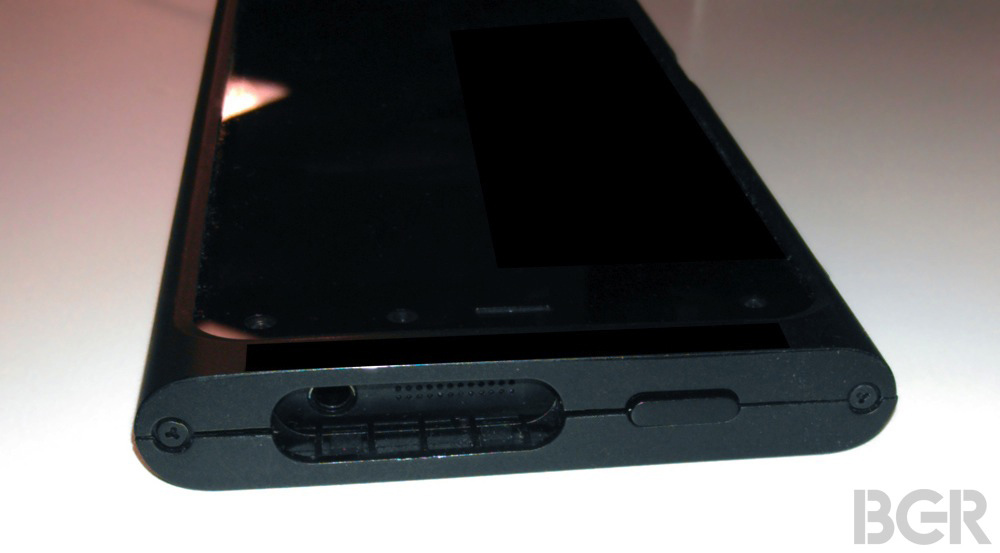
The most novel aspect of Amazon's upcoming smartphone is its 3D software interface and the hardware mechanism that enables it.

Our sources state that the new Amazon phone includes a total of six cameras.

The main rear camera is thought to feature a resolution of 13 megapixels, and the phone also includes a standard front-facing camera for video chats as well as Amazon's Mayday customer service feature.

Beyond those two units, the device houses an additional four front-facing cameras that work with other sensors to facilitate the software's 3D effects. One source tells us these four cameras, which are situated in each of the four corners on the face of the phone, are low-power infrared cameras.

The device's extra cameras are used to track the position of the user's face and eyes in relation to the phone's display. This allows Amazon's software to make constant adjustments to the positioning of on-screen elements, altering the perspective of visuals on the screen.

The result is a 3D experience without the need for 3D glasses or a parallax barrier in front the LCD panel like the solutions used by the Nintendo 3DS portable video game console and HTC's EVO 3D smartphone from 2011.

We're told there are several areas of the phone's software that utilize Amazon's glasses-free 3D effects.

Since the 3D interface is the phone's biggest point of differentiation, Amazon has tried to use its new technology in as many areas as possible. In fact, right from the start on the lock screen, Amazon's new phone will include several special wallpapers with perspectives that shift as the user tilts the phone from side to side as well as up and down.

Moving past the wallpapers, Amazon's 3D effect will also apply to application icons and other core elements of the user interface. Several main apps will be compatible as well; for example, we're told that moving the phone while using the maps application will change the view of various objects on the screen.

Another smart use for the phone's 3D effects is across Amazon's various stores, such as its book store, music store and the main Amazon digital market. By shifting the position of the phone, users are able to see three-dimensional product images at different angles to reveal surfaces that cannot be seen in 2D photos.

One source tells us Amazon is also working to recruit big outside developers in an effort to have a number of key third-party apps available at launch that take advantage of the phone's 3D interface. Amazon will make a set of APIs available to third parties and it will also assist them with development in other ways, we're told.

A report late last week from Re/code also said that Amazon is working to get third-party developers on board.

Our sources are not clear on exactly when Amazon's first smartphone will be released, though we're told the company may be targeting an announcement in the next two to three months and a launch sometime late this summer. We were also told the phone will initially be available only in the United States.

Amazon's second, lower-cost smartphone will then debut at a later time.


Evernote helps you remember everything and get organized effortlessly. Download Evernote.

Amazon Smartphone Photos, Specs and Details Revealed: Exclusive Report | BGR

After years of development, Amazon is finally close to unveiling the first of several own-brand smartphones.

At a distance, Amazon's upcoming flagship phone looks much like any other touchscreen phone on the market. But the company has spent years creating a unique and, at times, novel user experience that has two main focuses: Amazon products and services, and a custom 3D interface unlike anything we have seen before on a smartphone.

And so begins the story of Amazon's first smartphone.

Recent reports have shed some light on Amazon's plans to enter the competitive smartphone market with an own-brand handset. The Wall Street Journal reported last week that the company's first crack at a cell phone will be announced in June and released in the third quarter. The report also claimed that the phone features a glasses-free 3D interface.

An earlier research note sent to investors by plugged-in KGI Securities analyst Ming-Chi Kuo revealed a few key specs, including details about several internal components Amazon plans to use in the device.

BGR has spoken with multiple trusted sources and confirmed much of what has been reported thus far. We have also exclusively learned many new details surrounding Amazon's upcoming smartphone, which is set to debut in the coming months.

Finally, we have obtained exclusive photos of a prototype of the unreleased device, giving the world its first look at Amazon's hotly anticipated phone.

As can be seen in the images, the device is covered by a protective shell intended to prevent people without authorization from seeing the physical design of the phone. Some areas of the photos have also been blocked or otherwise obscured by BGR.

In the past, BGR has exclusively reported early unannounced details surrounding numerous Amazon products including Kindle eBook readers, Kindle Fire tablets, Amazon's current-generation Kindle Fire HDX tablets and, most recently, the Fire TV.

Amazon's first smartphone is one of at least two handsets the company is currently working on. We're told that the second, an entry-level device that will feature lower-end specs and a very competitive retail price, will launch sometime after the phone pictured here.

The device set to debut in the coming months will be a higher-end model that has been in development at Amazon for several years.

According to details from multiple sources, Amazon's first phone will be powered by a Qualcomm Snapdragon processor, and it will also include 2GB of RAM. It will run a heavily customized version of Google's Android operating system similar to the version that powers Amazon's tablets.

Our sources state that the phone's display will measure 4.7 inches diagonally, making the handset's screen a bit smaller than recent flagship offerings from Samsung and HTC. The handset also have comparatively low pixel density, featuring 720p HD resolution compared to 1080p HD resolution on many rival devices.

Apple's upcoming iPhone 6 is also rumored to feature a 4.7-inch screen with Retina resolution that falls short of full HD.

It's not clear exactly what Amazon plans to call its first phone.

The most novel aspect of Amazon's upcoming smartphone is its 3D software interface and the hardware mechanism that enables it.

Our sources state that the new Amazon phone includes a total of six cameras.

The main rear camera is thought to feature a resolution of 13 megapixels, and the phone also includes a standard front-facing camera for video chats as well as Amazon's Mayday customer service feature.

Beyond those two units, the device houses an additional four front-facing cameras that work with other sensors to facilitate the software's 3D effects. One source tells us these four cameras, which are situated in each of the four corners on the face of the phone, are low-power infrared cameras.

The device's extra cameras are used to track the position of the user's face and eyes in relation to the phone's display. This allows Amazon's software to make constant adjustments to the positioning of on-screen elements, altering the perspective of visuals on the screen.

The result is a 3D experience without the need for 3D glasses or a parallax barrier in front the LCD panel like the solutions used by the Nintendo 3DS portable video game console and HTC's EVO 3D smartphone from 2011.

We're told there are several areas of the phone's software that utilize Amazon's glasses-free 3D effects.

Since the 3D interface is the phone's biggest point of differentiation, Amazon has tried to use its new technology in as many areas as possible. In fact, right from the start on the lock screen, Amazon's new phone will include several special wallpapers with perspectives that shift as the user tilts the phone from side to side as well as up and down.

Moving past the wallpapers, Amazon's 3D effect will also apply to application icons and other core elements of the user interface. Several main apps will be compatible as well; for example, we're told that moving the phone while using the maps application will change the view of various objects on the screen.

Another smart use for the phone's 3D effects is across Amazon's various stores, such as its book store, music store and the main Amazon digital market. By shifting the position of the phone, users are able to see three-dimensional product images at different angles to reveal surfaces that cannot be seen in 2D photos.

One source tells us Amazon is also working to recruit big outside developers in an effort to have a number of key third-party apps available at launch that take advantage of the phone's 3D interface. Amazon will make a set of APIs available to third parties and it will also assist them with development in other ways, we're told.

A report late last week from Re/code also said that Amazon is working to get third-party developers on board.

Our sources are not clear on exactly when Amazon's first smartphone will be released, though we're told the company may be targeting an announcement in the next two to three months and a launch sometime late this summer. We were also told the phone will initially be available only in the United States.

Amazon's second, lower-cost smartphone will then debut at a later time.

Tags:
Amazon
Previous ArticlePreviousHere are all the passwords you need to change right now because of Heartbleed
Next ArticleNextThe NSA has its own suggestions for dealing with Heartbleed
Evernote helps you remember everything and get organized effortlessly. Download Evernote.

Thursday, April 3, 2014

Crowdfunding Is Not a Scam, It's Market Research - Bloomberg View


Crowdfunding Is Not a Scam, It's Market Research

7 Mar 28, 2014 12:05 PM ET

Crowdfunding sites such as Kickstarter and Indiegogo represent a classic entrepreneurial phenomenon: Once you roll out your great idea, customers use it in ways you didn't imagine, and you wind up in a different business than you expected.

Kickstarter's founders wanted to help artists raise money. Indiegogo co-founder Danae Ringelmann pictured aiding capital-strapped small-businesses owners like her parents. Neither intended their site to act as a test market. But, as the rags-to-riches story of virtual-reality firm Oculus shows, that's what they have become.

"It's a way to access capital, but what it's also become is a market-testing and validation platform," Ringelmann told the Dent the Future conference on Tuesday. "What we're doing is creating pre-markets for ideas," she said.

In theory, the sites operate a bit like a PBS pledge drive: Give us money for a good cause and we'll send you this nifty tote-bag. But the economics of running a campaign work best if whatever you're trying to do directly generates the premium. That way the same cash you use to complete your project gives you products or event tickets to hand out.

"If a project's goal is to produce a pure 'public good' -- like data, as it was in my case -- almost any exclusive, tangible reward offered to backers winds up simply adding costs, making it that much harder to raise the required funds," says Cosmo Wenman, who ran an unsuccessful Kickstarter campaign to finance 3-D scans of classic sculptures. "The tote-bag is not free." (He instead received funding from Autodesk.)

As a result, the most successful crowdfunding projects aren't charities. They're ventures that produce something people wish they could buy.

That makes crowdfunding a great way to test the market. "You're going directly to your fans, your customers, the people who're going to be your customers," said Ringelmann. You're finding out whether anyone is willing to pay for your great new idea.

When more than 9,500 people gave $2.4 million -- nearly 10 times the original goal -- to back the Oculus Rift headset on Kickstarter, it was clear the market was hungry for the invention. Although smaller donors received T-shirts or posters, the vast majority contributed enough to get either a prototype or a developer kit.

Now that Facebook is buying Oculus for $2 billion, critics are reverting to the original assumption that crowdfunding is primarily about raising money. "Talking people out of $2.4 million in exchange for zero percent equity is a perfectly legal scam," wrote my colleague Barry Ritholtz.

But it's not a scam at all. It's market research. In effect, customers placed pre-orders and received early products; why are they griping that they don't own a part of the business?

The backlash is largely Kickstarter's fault. It may not be running a scam, but it definitely sends mixed messages. Unlike Indiegogo, which prides itself on operating a neutral platform giving anybody's idea a market test, Kickstarter hasn't embraced its de facto transformation. It strictly curates the campaigns it hosts and, although it makes its biggest profits on technology products, it still exudes an artistic sensibility that isn't entirely comfortable with disruptive technology or large enterprises. It still talks as though it's PBS. "Kickstarter is not a store," it declares.

Indiegogo, by contrast, proudly touts itself as testing platform. "We allow entrepreneurs to prove themselves in a merit-based way," by discovering whether a venture can in fact attract interest and money from potential customers, said Ringelmann. The site even allows campaigns to swap in new perks or change the required giving levels. "You can test your pricing. You can test your features," she said. That kind of blunt sales-oriented language would be unheard of on Kickstarter.

Crowdfunding has enormous potential to expand entrepreneurial opportunity and reduce business risks. "We've actually gotten thank you notes," said Ringelmann, "from people who were highly unsuccessful in raising money that said, 'In three weeks I discovered that I had an idea that nobody wanted. You just saved me two years of my life.'"

But these benefits depend on recognizing this new institution for what it is: a way of taking pre-orders, not a charity pledge drive.

To contact the writer of this article: Virginia Postrel at vp@vpostrel.com.

To contact the editor responsible for this article: Tobin Harshaw at tharshaw@bloomberg.net.


Evernote helps you remember everything and get organized effortlessly. Download Evernote.

Tuesday, July 9, 2013

Caught on video: Fake hit man and Muskegon's widow wannabe discuss husband's murder | MLive.com

From Evernote:

Caught on video: Fake hit man and Muskegon's widow wannabe discuss husband's murder | MLive.com

Clipped from: http://www.mlive.com/news/muskegon/index.ssf/2013/07/caught_on_video_muskegons_wido.html

Caught on video: Fake hit man and Muskegon's widow wannabe discuss husband's murder 

Fake hit man, Julia Merfeld talk husband's murder (part 1) A fake hit man, actually a Michigan State police detective, and Julia Merfeld discuss plans to murder Merfeld's husband. Video was shot April 9, 2013. Footage courtesy of Muskegon County Prosecutor's Office and was edited for length by MLive.

MUSKEGON, MI – Julia Charlene Merfeld said she wanted her husband killed because "it was easier than divorcing him."

That explanation came in a meeting with a man Merfeld thought she was hiring to do the murder.

Merfeld, 21, of Muskegon didn't know the man was really an undercover police detective, or that she was being recorded on a hidden videocamera.

"When I first decided to do this … it's not that we weren't getting along," she says on the video. "But … terrible as it sounds, it was easier than divorcing him.

"You know, I didn't have to worry about the judgment of my family, I didn't have to worry about breaking his heart, all that stuff like this. It's, like, how I got a clean getaway."

Another motive, authorities have said, was the 27-year-old husband's $400,000 life insurance policy . Julia Merfeld told the fake hit man he'd be paid $50,000 from the proceeds, in a series of weekly $9,000 installments to avoid suspicion from her bank.

Merfeld pleaded guilty June 27 to solicitation to murder.

Her husband and intended victim asked that she get no jail time at all, the sentencing judge said in court at the time of her guilty plea. Instead, Chief Muskegon County Circuit Judge William C. Marietti committed to cap her minimum sentence at six years. The maximum can be anything up to life in prison, depending on Marietti's decision at her sentencing July 30.

After Merfeld's guilty plea, the Muskegon County Prosecutor's Office released videos of two meetings between Merfeld and a Michigan State Police detective. The recordings were released to MLive and the Muskegon Chronicle at a reporter's request.

Each conversation lasted about 11 minutes. Each took place in the fake hit man's vehicle parked outside the Harvey Street Meijer store in Fruitport Township. They were recorded on April 9 and 10, 2013. Merfeld was arrested soon after the second meeting and has been lodged in the Muskegon County Jail ever since.

The recordings are almost startlingly sharp. In them, the baby-faced young wife, wearing a Batman sweatshirt in the second meeting, discusses her murder plan in a matter-of-fact manner. Occasionally she laughs. She calmly discusses possible dates for the killing, checking her calendar on her Batman-stickered smartphone.

At one point late in the second conversation, she briefly appears to be having second thoughts. After the supposed hit man tells her he'll fire two bullets into her husband's head and that "he's gonna die," she smiles uneasily, says "it makes me sad," and at one point says softly, "It's a bad idea for me."

But within seconds she's back on track, saying "OK" after the fake killer tells her the killing can't be called off "after today." And seconds after that she interrupts him to ask "what happens if you get caught?" He assures her he'll "take the hit" and not give her up as long as she pays him, to which she replies, "absolutely."

The man who tipped off police, her co-worker Carlos Ramos, told MLive earlier that Merfeld offered him $50,000 to kill her husband. Instead he called police, who then set up the meetings that led to her arrest.

Merfeld and her husband had recently moved to Muskegon from New Jersey as the result of a job transfer for the husband. They have two young children who were staying with relatives in New Jersey at the time of the April meetings.

At no time in the conversations does Merfeld express any hostility toward her husband or complain of any action of his. She stresses that she doesn't want him to suffer.

When the "hit man" asks whether she wants him to use a gun or a knife, she says, "unless you can do it painlessly breaking his neck."

Early in the first conversation they discuss her preference that the victim be killed outdoors rather than in their West Forest Avenue home, for a couple of reasons. For one, Merfeld wanted a friend to move in with her after his death, and she didn't want the woman to be scared of moving into the house after it had been broken into.

Also, she says, a shooting indoors "would be messy in the house," then laughs.

By the second meeting, it's been decided the murder will be done inside the Merfelds' home while Julia is at work. Her husband will be in the pantry, she tells the "hit man." The hired killer will steal items such as a computer to make it look like a robbery.

For the second meeting, Merfeld brings along and hands the "hit man" a sheaf of notes he has requested, including directions to the home and a floor plan, then a photo of her husband, saying, "that's him." She also hands the purported killer a $100 bill as a down payment to show she's serious, as he had requested in the first meeting.

As the final conversation ends, the supposed killer shakes Merfeld's hand and wishes her luck. She replies with a smile just before she exits the vehicle:

"Thank you. Good luck to you, too."

Email John Hausman at jhausman@mlive.com or follow him on Twitter at @johnshausman


Monday, July 8, 2013

Yes, Please | Party of One - NYTimes.com

From Evernote:

Yes, Please | Party of One - NYTimes.com

Clipped from: http://tmagazine.blogs.nytimes.com/2013/05/09/yes-please-party-of-one/

Yes, Please | Party of One 

Slim Aarons/Getty ImagesThe photographer Slim Aarons lounges by the Acropolis, circa 1955.

Why suffer through grumbling vacations with others when it's so much more blissful to go it alone?

The first rule of travel is that you should always go with someone you love, which is why I travel alone. The writer's life is more openly narcissistic than most, yet it takes a true connoisseur of self-involvement, a grand master in the art of selfishness, to experience the world's delights as they are meant to be enjoyed: through one pair of eyes, via one set of ears, with the perfect use of your own nostrils, tongue and touch. I believe that traveling alone is the last great test of who you are in a world where everyone aches to be the same.

I mean, you meet people. But you also meet yourself. That is the beauty of going it alone. For me, it all started with a trip from Scotland to America when I was 18. I had been there in books and movies, of course, and, in my youth, I had studied my countryman Robert Louis Stevenson's strictures about New York. "You must speak to no one in the streets," he was told, "as they would not leave you till you were rooked and beaten. You must enter a hotel with military precautions." As it turned out, I fell on New York like an old pal. I arrived and immediately went for a drink on 34th Street and thought I was in heaven. The heaven was being oneself. Perhaps even being oneself for the very first time, without tradition scrutinizing you, without expectation hounding you, without class defining you and without a sense of other people lording it over you. That's an unforgettable experience, especially in youth, because the lasting feature of the solo traveler lies in his hunger for singularity. Even today, when I grab my passport and head for the airport, I have something of Emerson in mind, wandering into the woods to establish "an original relation to the universe." But I also have Jean-Paul Sartre in mind: "Hell is other people."

The fun starts with the choices. Will I be solo tobogganing in New Zealand? Will I be watching Wagner's "Ring" cycle in a series of Bavarian chapels? Attending a vegetarian cooking course in the Taurus Mountains of Turkey? Drinking approximately 400 shots of tequila on some God-forsaken beach in Thailand? Doing yoga in Amorgos, Greece, in front of a perfect blue sea? Or will I be cycling through the back roads of France with the promise of lunch up ahead and no conversation?

Every vacation is an ego trip for somebody. It's just that in families the person actually commanding the ego trip has to pretend he or she is running a functioning democracy. (And vacations, like failed states, are always run by one person.) People argue so much on vacation because the occasion so often falls short of the desire: the desire is for rest, peace, no pressure, and a sense of being away from one's usual self, and your average family holiday sets fire in comic sequence to each of these high hopes. And often as memorable and meaningful as a family holiday is, it just doesn't feel like a holiday.

What feels like a holiday is turning up alone at the Hotel Danieli in Venice on a beautiful day. You open the window onto the Grand Canal and you feel the breeze. You order tea from room service and press your face against a cotton pillow. You take out the books you will read and you run a warm bath. You lift pictures of your loved ones from your suitcase and place them gingerly on the bedside cabinet and blow them a kiss. You switch off your phone. Then you take off your shoes and die of bliss. "From midday to dusk I have been roaming the streets," wrote Henry James in a letter to his brother William from Rome. "At last — for the first time — I live!"

Courtesy of Alexander and Bonin, New YorkA photograph from Robert Kinmont's ''8 Natural Handstands'' series (1969/2009).

Let me dispel a few myths. You will be lonely. No: you won't. My solo travels in Paris have brought many perfect hours of being alone but not a moment of loneliness. People who depend on other people are often in hiding from themselves. Two and a quarter million people live in the City of Light: you will see many of them and you will pass them in the street, but when you see Notre Dame after dark and walk home and perhaps stop to have a drink in the Marais, you can feel that the only thing that is missing from your experience is the common dependency on someone to distract your attention. You are living without it: you are on vacation.

Distraction can be nice. Of course, it can. One of the reasons many people travel is to find a structured way of distracting themselves to the point of oblivion. I've been to Ibiza with a crowd of boys and forgotten my own name. I once went on a group holiday to Machu Picchu on which the people — a group of solo travelers looking for adventure — spent the whole time involved in a rolling soap opera that only used the forgotten city as a kind of verdant background. They couldn't see the sites: they only saw each other and themselves in each other's eyes. Everyone needs something specific, I guess, and you can't travel far away from your basic needs. But traveling alone offers the chance to test the limits of what you think you know about yourself. Who knew that he needed a barefoot walk on a long white beach and the sight of a thousand jellyfish thrown up on the sand? Who knew that he needed a bottle shop serving perfect Australian shiraz, a jacaranda tree sprouting blue against a hopeful red sky over Byron Bay — who knew he needed these exact things in order to know he could survive the sickness of a child and the depression of a parent? I know that man, reader, and he went there alone.

Show me the world, says the group traveler. And show me two weeks when I don't have to think. Fair enough. But not for me: I want to think new things on holiday and the best way to do that is to go it alone, allowing yourself a space — a beautiful space, with any luck — that is circumscribed neither by your need to perform nor your need to blame. Get up when you like. Skip as many museums as you like. Eat or don't eat. Dance or don't dance. Swim far out if you want to. Drink Champagne at breakfast. Write a paragraph if you have one to write. Say nothing for days and dream of home. Keep the light on all night.

I love a solo holiday. It tends to refresh the part of oneself that is most depleted by modern life — patience. I once went to Germany on a 10-city expedition. It was winter and the trains slogged through enchanted forests and past emerald lakes to places where castles and universities jostled in the mind beside evidence of man-made problems. I loved the snow, and felt, halfway through my travels, that I was actually moving slower than I had when I was back at home. I was taking my time, giving things their due, and the solo holiday had in some way increased my reserves of contentment. I had been on mindless holidays and they were fun and I couldn't remember them. But my travels in Germany left me quite refreshed with thoughtfulness.

I've had solo pints of Guinness in the pubs of County Kerry and County Cork. I've walked across the sage- and juniper-scented maquis of Corsica on a spring day, where you can still find the world of Napoleon's childhood. More than once I went to the Isle of Iona in the Scottish Hebrides, the burial ground of the early Scottish kings, and watched darkness descend on the Sound of Iona while evensong came from the old monastery. I wasn't on these travels for visions or transformation, but simply to feel the force of the world, for a day, for a night, as it operates outside the chatter of commerce or media or mass psychology. I love these things, but not on holiday, when one might hope for a place where you can resist the temptation to be drowned out.

It's not for everybody. It's not for people who are apt to get anxious about the good times they could be having. Life is so virtual nowadays that people might spend their lives casually mourning a version of reality that can only exist elsewhere. The virtue of many modern holiday destinations is that they provide the perfect conditions in which high-paying customers can feel entirely homesick. This has been excellent news for the comic novel, but I'm sure I couldn't love it. The wanderlust of the solo traveler doesn't kill homesickness, it partners it, making the vacation all the better for involving one's profound wish to go home to normal life a little changed. If I ruled the world, and you can rest assured that I don't, I would send each person for a fortnight away on their own. It wouldn't serve the divorce lawyers or the councils of war very well, but it would make people much happier to know the entire world was theirs.


This post has been revised to reflect the following correction:

Correction: May 19, 2013

An article on May 12 about the joys of traveling alone quoted incorrectly from a letter that Henry James wrote to his brother William from Rome. He boasted about roaming the streets "from midday to dusk" (not "dust").

A version of this article appeared in print on 05/12/2013, on page M2100 of the NewYork edition with the headline: Party of One.
 

Sunday, June 30, 2013

www.vulture.com/2013/06/the-room-10th-anniversary-history.html


Khalid Shagari shared with you:


  www.vulture.com/2013/06/the-room-10th-anniversary-history.html  
 
  vulture.com  


Don't have time to view this now?
Sign up for Pocket and view this page later.
     
  Get Pocket  


The Room: The Decade’s Biggest Cult Film -- Vulture

From Evernote:

The Room: The Decade's Biggest Cult Film -- Vulture

Clipped from: http://www.vulture.com/2013/06/the-room-10th-anniversary-history.html

How The Room Became the Biggest Cult Film of the Past Decade 

Ten years ago, in June 2003, a small independent film with a terrible script, a no-name director, and a cast of unknowns opened for a short run in Los Angeles. It was panned by the few critics who saw it and closed two weeks later, having grossed $1,800. But the film had something that set it apart. For while there are plenty of bad movies, there are no movies that are bad in all the ways The Room is bad. It suspends all normal rules of drama. Conflicts are introduced and then disappear instantly. Characters experience rapid mood swings, and everyone speaks in a weird brand of English filled with bizarre idioms. ("Keep your stupid comments in your pocket!") The sex scenes are scarier than the scary scenes.

The Room hit theaters at the right time. As it turns out, its unending series of bizarre moments were perfect for the dawn of the Internet's GIF and YouTube culture. As word of "the Worst Movie Ever Made" spread throughout message boards, an embryonic Room fandom coalesced around a series of midnight screenings in L.A. The movie's director became the center of a strange cult of personality, one that grew to include some of the top names in Hollywood. With their help, The Room became an international phenomenon, replete with a computer game , a stage adaptation, countless memes , celebrity parodies , ironic scholarship , an upcoming tell-all memoir , and regular screenings in three countries. Here's how the biggest cult movie of the past decade came to be.

Sometime in the Twentieth Century  
Tommy Wiseau, The Room's mysterious star-director-writer, is born. Little else is known.  

Wiseau: "[My past] has nothing to do with what I do. My private life is my private life."

Juliette Danielle, Room cast member : "We tried for a long time to find out where he's from. We never got an answer."

Sometime in the Late Twentieth Century
Wiseau is inspired.

Wiseau: "I got the idea of The Room from life," he says. "I conducted a lot of research, detailed work about human behavior, based on my environment. So I decided that I have this 'concept,' you know, about human behavior, and that's where everything started.

The idea begins as a 600-page book, which Wiseau considers turning into a stage play. Eventually, he decides to make a film, written by, directed by, and starring himself. 

1998  
In an acting class in San Francisco, Wiseau meets Greg Sestero, who will become his right-hand man.

Sestero : "He went up onstage and was just so entertaining. The whole class was laughing and chanting his name, and he was getting into it with the teacher and I thought, This guy's kind of cool. We just clicked. He told me, 'I have a movie I'd love to make, and I think you'd be great.'"

2002  
Production begins on The Room, though how Wiseau raised the film's $6 million budget is a mystery. In interviews, the director says that he got it from his leather jacket business.

Wiseau : ''If you work, you have to save money, right? I didn't get money from the sky. I was preparing, let's put it this way.''

The cast has no illusions that they're making a serious film.

Danielle : "I can remember one time that I just lost it. It's the line where Johnny has locked himself in the bathroom and he says, 'In a few minutes, bitch.' I was doing okay until I saw the entire crew in my field of vision, stifling their laughter. I couldn't help it. Tommy came out and demanded to know what was so funny. That made it worse!"

But Wiseau's eccentricities hamper production.

Anonymous crew member : "[The script] was actually a lot longer. There was stuff that was just unsayeable. I know it's hard to imagine there was stuff that was worse. But there was.''

Sestero: "[Production lasted] almost six months. It took longer than Transformers. That is sad."

June 27, 2003  
The film has its world premiere in Los Angeles. Wiseau arrives in a limousine.

Sestero: "People were hypnotized with laughter. Some people [walking out of the theater] looked dismayed. One guy said he may never get hard again."

Variety  critic Scott Foundas : "Given audience reaction at screening attended, pic may be something of a first: A movie that prompts most of its viewers to ask for their money back — before even 30 minutes have passed."

By the end of its two-week run, the film has found a super-fan in screenwriter Michael Rousselet.

Rousselet : "'It was like our own private Mystery Science Theater. I was calling friends during the end and saying, 'You have to come to this movie.' We saw it four times in three days, and on the last day I had over 100 people there.''

A Los Angeles billboard that was essentially The Room's only piece of advertising.

Late 2003  
The first wave of Room diehards begin a campaign to bring the film back.

Wiseau : "We got several phone calls from the theater that people were campaigning because they wanted to see The Room. I said to myself, What the heck? We got thousands of e-mails."

2004

The Room begins regular midnight screenings at the Laemmle Sunset in Los Angeles. Fans take to the Internet to sing the film's praises.

IMDb user Brickyard Jimmy : "See this film at all costs. See it twice. Or three times. Or as one kid that I met from Woodland Hills has, 12 times! See it until you can recite every precious line of dialogue this movie has to offer. Let The Room become your new religion."

Room fever infects the L.A. comedy scene. Members of the State seem particularly prone.

David Wain : "I was at Paul Rudd's house a couple of years ago, and he said, 'You have to watch this. Within two minutes, I'm like, 'Okay, this is my favorite thing I've ever seen.'''

December 2005  
Wiseau releases the film on DVD, allowing Room fans to mock the film from the comfort of their homes.

May 5, 2006  
NPR runs the first trend piece on Room screenings.

NPR : "During the movie, audience members shout out their own commentary about the dialogue, the sets — and notably, the framed photograph of a spoon that inexplicably reappears. Each time this happens, plastic spoons are thrown at the screen, in the can-do spirit of Rocky Horror Picture Show fans"

March 8. 2009  
Tim and Eric, Room fans both, get Wiseau to guest-direct an episode of Awesome Show. Watch it here.

May 21, 2009  
Monthly midnight screenings begin in New York City. The Room is now bicoastal.

July 24, 2009  
The Room makes its London Premiere at Soho's Prince Charles Theater.

The Independent : "The Room's crappiness is so compelling that, rather than market it as the Greek tragedy it was so obviously meant to be be, Wiseau nowadays insists it was conceived as black comedy.

April 30, 2010  
The Room celebrates its one-year NYC premiere with a sell-out show at the 1,200-seat Ziegfield Theater. Wiseau is on hand to embrace the circus.

Entertainment Weekly :"While Sestero hung back, quietly signing autographs and taking pictures with fans, Wiseau — wearing a suit and those trademark sunglasses — was immediately bombarded with requests to pose in photos with football-wielding fans dressed in his likeness, and to sign shirts that read 'I heart Tommy Wiseau.' […] In fact, during the half hour that Wiseau rubbed elbows with fans outside the theatre, he was constantly surrounded by a mob worthy of Rob Pattinson, which made unknowing passersby curiously ask folks in line, "Who is that?"

September 7, 2010  
With the arrival of an online computer game, The Room becomes fully meme-ified.

Vulture : "Can you find Lisa's red dress in time?"

May 23, 2011  
Sestero becomes Wiseau's Boswell in earnest, signing a book deal with Simon & Schuster to write a tell-all about the making of the film. The Disaster Artist  will hit shelves in October.

June 11, 2011  
Wiseau's vision finally comes full circle with a stage adaptation of The Room, which premieres  at the AFI Silver Screen in Maryland. (Watch a video of it here .)

2013  
Wiseau announces a special tenth-anniversary tour for the film , with appearances in Hollywood, Minneapolis, and Denver. He will likely introduce each of them with what has become his trademark phrase.

Wiseau: "I always say, 'You can laugh, you can cry, you can express yourself, but please don't hurt each other.'"