| Your Bloomberg.com account was recently changed. If you did not request this change, contact us. - The Bloomberg.com Team Visit Bloomberg.com for the latest US and international news and market data. Please do not reply to this message; it was sent from an unmonitored email address. ------------------ Manage your Account | Contact Us | Advertise |
Thursday, July 14, 2016
Bloomberg Account Information Change Confirmation

Sunday, July 27, 2014
Bloomberg Hires a Founder of The Verge to Lead Online Initiatives - NYTimes.com
http://www.nytimes.com/2014/07/25/business/media/josh-topolsky-of-the-verge-is-joining-bloomberg.html
Bloomberg Hires a Founder of The Verge to Lead Online Initiatives
By RAVI SOMAIYA
July 24, 2014
Josh Topolsky, the co-founder of the technology website The Verge, will join Bloomberg as the editor of a series of online ventures it is introducing as part of a revamped journalism strategy.
Mr. Topolsky will start Aug. 4, and will report to Josh Tyrangiel, the editor of Bloomberg Businessweek, and Justin Smith, the chief executive of the Bloomberg media group and the architect of a plan to reposition the company as a multimedia destination.
"I think Josh is an amazing entrepreneur," Mr. Smith said. "He has been more successful than anyone in building new digitally centered brands."
Mr. Topolsky, who was the editor in chief of the technology site Engadget until 2011, helped to found The Verge, and was one of the creators of its parent company, Vox Media. He will develop and run Bloomberg's new ventures, which will cover specific topic areas like politics and luxury.

With Bloomberg's resources, Joshua Topolsky said, the job is "an opportunity to build a 21st-century media company."
Slaven Vlasic / Getty Images
"The potential is massive," Mr. Topolsky said of his decision to take the job. "They have the resources and the technology. It's an opportunity to build a 21st-century media company to scale."
Mr. Topolsky will be replaced at The Verge by Nilay Patel, its former managing editor, now the acting managing editor of Vox.com. Dieter Bohn will become executive editor of the technology site.
In joining Bloomberg, which had been viewed as a lucrative but not necessarily cutting-edge destination for reporters and editors, Mr. Topolsky is bucking the trend of young, web-native journalists leaving established media brands for smaller, more nimble start-ups. Those include Ezra Klein, formerly of The Washington Post, who moved to Vox Media.
"They're very different companies," Mr. Topolsky said, "with very different challenges and goals." He added, "Right now all I see is this huge potential and huge resources to build unbelievably strong brands."
Bloomberg, which relies on its financial information terminals for a large percentage of its annual revenue, has recently hired other prominent journalists. In May, John Heilemann and Mark Halperin, political reporters known for detailed, gossip-filled books like "Game Change" and "Double Down," joined to start a new site that will focus on American politics and policy.
Though there will most likely be further big-name hires in the future, Mr. Smith said that Bloomberg would now focus on "doing tons of things in the trenches," including building new video and web products.
Thursday, May 8, 2014
Evernote:Nintendo to Sell New Consoles for Emerging Markets - Bloomberg


| Evernote helps you remember everything and get organized effortlessly. Download Evernote. |
Tuesday, April 15, 2014
Amazon Smartphone Photos, Specs and Details Revealed: Exclusive Report | BGR
This is Amazon's smartphone
BGR gives the world an exclusive first look at the unannounced smartphone Amazon is set to debut in the coming months
Exclusive

After years of development, Amazon is finally close to unveiling the first of several own-brand smartphones.
At a distance, Amazon's upcoming flagship phone looks much like any other touchscreen phone on the market. But the company has spent years creating a unique and, at times, novel user experience that has two main focuses: Amazon products and services, and a custom 3D interface unlike anything we have seen before on a smartphone.
And so begins the story of Amazon's first smartphone.
Recent reports have shed some light on Amazon's plans to enter the competitive smartphone market with an own-brand handset. The Wall Street Journal reported last week that the company's first crack at a cell phone will be announced in June and released in the third quarter. The report also claimed that the phone features a glasses-free 3D interface.
An earlier research note sent to investors by plugged-in KGI Securities analyst Ming-Chi Kuo revealed a few key specs, including details about several internal components Amazon plans to use in the device.
BGR has spoken with multiple trusted sources and confirmed much of what has been reported thus far. We have also exclusively learned many new details surrounding Amazon's upcoming smartphone, which is set to debut in the coming months.
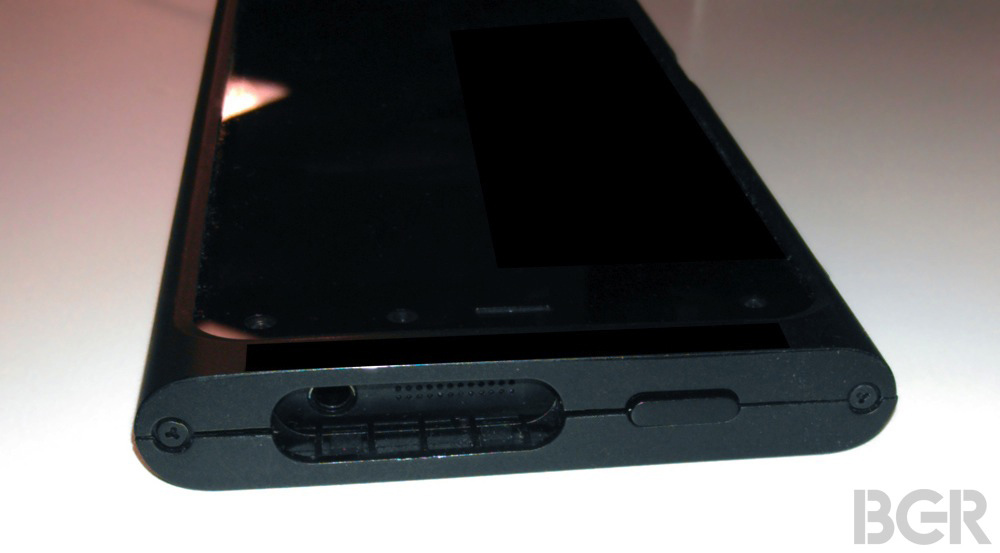
Finally, we have obtained exclusive photos of a prototype of the unreleased device, giving the world its first look at Amazon's hotly anticipated phone.
As can be seen in the images, the device is covered by a protective shell intended to prevent people without authorization from seeing the physical design of the phone. Some areas of the photos have also been blocked or otherwise obscured by BGR.
In the past, BGR has exclusively reported early unannounced details surrounding numerous Amazon products including Kindle eBook readers, Kindle Fire tablets, Amazon's current-generation Kindle Fire HDX tablets and, most recently, the Fire TV.

Amazon's first smartphone is one of at least two handsets the company is currently working on. We're told that the second, an entry-level device that will feature lower-end specs and a very competitive retail price, will launch sometime after the phone pictured here.
The device set to debut in the coming months will be a higher-end model that has been in development at Amazon for several years.
According to details from multiple sources, Amazon's first phone will be powered by a Qualcomm Snapdragon processor, and it will also include 2GB of RAM. It will run a heavily customized version of Google's Android operating system similar to the version that powers Amazon's tablets.
Our sources state that the phone's display will measure 4.7 inches diagonally, making the handset's screen a bit smaller than recent flagship offerings from Samsung and HTC. The handset also have comparatively low pixel density, featuring 720p HD resolution compared to 1080p HD resolution on many rival devices.
Apple's upcoming iPhone 6 is also rumored to feature a 4.7-inch screen with Retina resolution that falls short of full HD.
It's not clear exactly what Amazon plans to call its first phone.
The most novel aspect of Amazon's upcoming smartphone is its 3D software interface and the hardware mechanism that enables it.
Our sources state that the new Amazon phone includes a total of six cameras.
The main rear camera is thought to feature a resolution of 13 megapixels, and the phone also includes a standard front-facing camera for video chats as well as Amazon's Mayday customer service feature.
Beyond those two units, the device houses an additional four front-facing cameras that work with other sensors to facilitate the software's 3D effects. One source tells us these four cameras, which are situated in each of the four corners on the face of the phone, are low-power infrared cameras.
The device's extra cameras are used to track the position of the user's face and eyes in relation to the phone's display. This allows Amazon's software to make constant adjustments to the positioning of on-screen elements, altering the perspective of visuals on the screen.
The result is a 3D experience without the need for 3D glasses or a parallax barrier in front the LCD panel like the solutions used by the Nintendo 3DS portable video game console and HTC's EVO 3D smartphone from 2011.
We're told there are several areas of the phone's software that utilize Amazon's glasses-free 3D effects.
Since the 3D interface is the phone's biggest point of differentiation, Amazon has tried to use its new technology in as many areas as possible. In fact, right from the start on the lock screen, Amazon's new phone will include several special wallpapers with perspectives that shift as the user tilts the phone from side to side as well as up and down.
Moving past the wallpapers, Amazon's 3D effect will also apply to application icons and other core elements of the user interface. Several main apps will be compatible as well; for example, we're told that moving the phone while using the maps application will change the view of various objects on the screen.
Another smart use for the phone's 3D effects is across Amazon's various stores, such as its book store, music store and the main Amazon digital market. By shifting the position of the phone, users are able to see three-dimensional product images at different angles to reveal surfaces that cannot be seen in 2D photos.
One source tells us Amazon is also working to recruit big outside developers in an effort to have a number of key third-party apps available at launch that take advantage of the phone's 3D interface. Amazon will make a set of APIs available to third parties and it will also assist them with development in other ways, we're told.
A report late last week from Re/code also said that Amazon is working to get third-party developers on board.
Our sources are not clear on exactly when Amazon's first smartphone will be released, though we're told the company may be targeting an announcement in the next two to three months and a launch sometime late this summer. We were also told the phone will initially be available only in the United States.
Amazon's second, lower-cost smartphone will then debut at a later time.
| Evernote helps you remember everything and get organized effortlessly. Download Evernote. |
Amazon Smartphone Photos, Specs and Details Revealed: Exclusive Report | BGR
By Zach Epstein on Apr 15, 2014 at 10:29 AM
After years of development, Amazon is finally close to unveiling the first of several own-brand smartphones.
At a distance, Amazon's upcoming flagship phone looks much like any other touchscreen phone on the market. But the company has spent years creating a unique and, at times, novel user experience that has two main focuses: Amazon products and services, and a custom 3D interface unlike anything we have seen before on a smartphone.
And so begins the story of Amazon's first smartphone.
Recent reports have shed some light on Amazon's plans to enter the competitive smartphone market with an own-brand handset. The Wall Street Journal reported last week that the company's first crack at a cell phone will be announced in June and released in the third quarter. The report also claimed that the phone features a glasses-free 3D interface.
An earlier research note sent to investors by plugged-in KGI Securities analyst Ming-Chi Kuo revealed a few key specs, including details about several internal components Amazon plans to use in the device.
BGR has spoken with multiple trusted sources and confirmed much of what has been reported thus far. We have also exclusively learned many new details surrounding Amazon's upcoming smartphone, which is set to debut in the coming months.
Finally, we have obtained exclusive photos of a prototype of the unreleased device, giving the world its first look at Amazon's hotly anticipated phone.
As can be seen in the images, the device is covered by a protective shell intended to prevent people without authorization from seeing the physical design of the phone. Some areas of the photos have also been blocked or otherwise obscured by BGR.
In the past, BGR has exclusively reported early unannounced details surrounding numerous Amazon products including Kindle eBook readers, Kindle Fire tablets, Amazon's current-generation Kindle Fire HDX tablets and, most recently, the Fire TV.
Amazon's first smartphone is one of at least two handsets the company is currently working on. We're told that the second, an entry-level device that will feature lower-end specs and a very competitive retail price, will launch sometime after the phone pictured here.
The device set to debut in the coming months will be a higher-end model that has been in development at Amazon for several years.
According to details from multiple sources, Amazon's first phone will be powered by a Qualcomm Snapdragon processor, and it will also include 2GB of RAM. It will run a heavily customized version of Google's Android operating system similar to the version that powers Amazon's tablets.
Our sources state that the phone's display will measure 4.7 inches diagonally, making the handset's screen a bit smaller than recent flagship offerings from Samsung and HTC. The handset also have comparatively low pixel density, featuring 720p HD resolution compared to 1080p HD resolution on many rival devices.
Apple's upcoming iPhone 6 is also rumored to feature a 4.7-inch screen with Retina resolution that falls short of full HD.
It's not clear exactly what Amazon plans to call its first phone.
The most novel aspect of Amazon's upcoming smartphone is its 3D software interface and the hardware mechanism that enables it.
Our sources state that the new Amazon phone includes a total of six cameras.
The main rear camera is thought to feature a resolution of 13 megapixels, and the phone also includes a standard front-facing camera for video chats as well as Amazon's Mayday customer service feature.
Beyond those two units, the device houses an additional four front-facing cameras that work with other sensors to facilitate the software's 3D effects. One source tells us these four cameras, which are situated in each of the four corners on the face of the phone, are low-power infrared cameras.
The device's extra cameras are used to track the position of the user's face and eyes in relation to the phone's display. This allows Amazon's software to make constant adjustments to the positioning of on-screen elements, altering the perspective of visuals on the screen.
The result is a 3D experience without the need for 3D glasses or a parallax barrier in front the LCD panel like the solutions used by the Nintendo 3DS portable video game console and HTC's EVO 3D smartphone from 2011.
We're told there are several areas of the phone's software that utilize Amazon's glasses-free 3D effects.
Since the 3D interface is the phone's biggest point of differentiation, Amazon has tried to use its new technology in as many areas as possible. In fact, right from the start on the lock screen, Amazon's new phone will include several special wallpapers with perspectives that shift as the user tilts the phone from side to side as well as up and down.
Moving past the wallpapers, Amazon's 3D effect will also apply to application icons and other core elements of the user interface. Several main apps will be compatible as well; for example, we're told that moving the phone while using the maps application will change the view of various objects on the screen.
Another smart use for the phone's 3D effects is across Amazon's various stores, such as its book store, music store and the main Amazon digital market. By shifting the position of the phone, users are able to see three-dimensional product images at different angles to reveal surfaces that cannot be seen in 2D photos.
One source tells us Amazon is also working to recruit big outside developers in an effort to have a number of key third-party apps available at launch that take advantage of the phone's 3D interface. Amazon will make a set of APIs available to third parties and it will also assist them with development in other ways, we're told.
A report late last week from Re/code also said that Amazon is working to get third-party developers on board.
Our sources are not clear on exactly when Amazon's first smartphone will be released, though we're told the company may be targeting an announcement in the next two to three months and a launch sometime late this summer. We were also told the phone will initially be available only in the United States.
Amazon's second, lower-cost smartphone will then debut at a later time.
- Tags:
- Amazon
| Evernote helps you remember everything and get organized effortlessly. Download Evernote. |
Thursday, April 3, 2014
Crowdfunding Is Not a Scam, It's Market Research - Bloomberg View
Crowdfunding Is Not a Scam, It's Market Research
Crowdfunding sites such as Kickstarter and Indiegogo represent a classic entrepreneurial phenomenon: Once you roll out your great idea, customers use it in ways you didn't imagine, and you wind up in a different business than you expected.
Kickstarter's founders wanted to help artists raise money. Indiegogo co-founder Danae Ringelmann pictured aiding capital-strapped small-businesses owners like her parents. Neither intended their site to act as a test market. But, as the rags-to-riches story of virtual-reality firm Oculus shows, that's what they have become.
"It's a way to access capital, but what it's also become is a market-testing and validation platform," Ringelmann told the Dent the Future conference on Tuesday. "What we're doing is creating pre-markets for ideas," she said.
In theory, the sites operate a bit like a PBS pledge drive: Give us money for a good cause and we'll send you this nifty tote-bag. But the economics of running a campaign work best if whatever you're trying to do directly generates the premium. That way the same cash you use to complete your project gives you products or event tickets to hand out.
"If a project's goal is to produce a pure 'public good' -- like data, as it was in my case -- almost any exclusive, tangible reward offered to backers winds up simply adding costs, making it that much harder to raise the required funds," says Cosmo Wenman, who ran an unsuccessful Kickstarter campaign to finance 3-D scans of classic sculptures. "The tote-bag is not free." (He instead received funding from Autodesk.)
As a result, the most successful crowdfunding projects aren't charities. They're ventures that produce something people wish they could buy.
That makes crowdfunding a great way to test the market. "You're going directly to your fans, your customers, the people who're going to be your customers," said Ringelmann. You're finding out whether anyone is willing to pay for your great new idea.
When more than 9,500 people gave $2.4 million -- nearly 10 times the original goal -- to back the Oculus Rift headset on Kickstarter, it was clear the market was hungry for the invention. Although smaller donors received T-shirts or posters, the vast majority contributed enough to get either a prototype or a developer kit.
Now that Facebook is buying Oculus for $2 billion, critics are reverting to the original assumption that crowdfunding is primarily about raising money. "Talking people out of $2.4 million in exchange for zero percent equity is a perfectly legal scam," wrote my colleague Barry Ritholtz.
But it's not a scam at all. It's market research. In effect, customers placed pre-orders and received early products; why are they griping that they don't own a part of the business?
The backlash is largely Kickstarter's fault. It may not be running a scam, but it definitely sends mixed messages. Unlike Indiegogo, which prides itself on operating a neutral platform giving anybody's idea a market test, Kickstarter hasn't embraced its de facto transformation. It strictly curates the campaigns it hosts and, although it makes its biggest profits on technology products, it still exudes an artistic sensibility that isn't entirely comfortable with disruptive technology or large enterprises. It still talks as though it's PBS. "Kickstarter is not a store," it declares.
Indiegogo, by contrast, proudly touts itself as testing platform. "We allow entrepreneurs to prove themselves in a merit-based way," by discovering whether a venture can in fact attract interest and money from potential customers, said Ringelmann. The site even allows campaigns to swap in new perks or change the required giving levels. "You can test your pricing. You can test your features," she said. That kind of blunt sales-oriented language would be unheard of on Kickstarter.
Crowdfunding has enormous potential to expand entrepreneurial opportunity and reduce business risks. "We've actually gotten thank you notes," said Ringelmann, "from people who were highly unsuccessful in raising money that said, 'In three weeks I discovered that I had an idea that nobody wanted. You just saved me two years of my life.'"
But these benefits depend on recognizing this new institution for what it is: a way of taking pre-orders, not a charity pledge drive.
To contact the writer of this article: Virginia Postrel at vp@vpostrel.com.
To contact the editor responsible for this article: Tobin Harshaw at tharshaw@bloomberg.net.
| Evernote helps you remember everything and get organized effortlessly. Download Evernote. |
Tuesday, July 9, 2013
Caught on video: Fake hit man and Muskegon's widow wannabe discuss husband's murder | MLive.com
From Evernote: |
Caught on video: Fake hit man and Muskegon's widow wannabe discuss husband's murder | MLive.comClipped from: http://www.mlive.com/news/muskegon/index.ssf/2013/07/caught_on_video_muskegons_wido.html |
Caught on video: Fake hit man and Muskegon's widow wannabe discuss husband's murder
Fake hit man, Julia Merfeld talk husband's murder (part 1) A fake hit man, actually a Michigan State police detective, and Julia Merfeld discuss plans to murder Merfeld's husband. Video was shot April 9, 2013. Footage courtesy of Muskegon County Prosecutor's Office and was edited for length by MLive.
MUSKEGON, MI – Julia Charlene Merfeld said she wanted her husband killed because "it was easier than divorcing him."
That explanation came in a meeting with a man Merfeld thought she was hiring to do the murder.
Merfeld, 21, of Muskegon didn't know the man was really an undercover police detective, or that she was being recorded on a hidden videocamera."When I first decided to do this … it's not that we weren't getting along," she says on the video. "But … terrible as it sounds, it was easier than divorcing him.
"You know, I didn't have to worry about the judgment of my family, I didn't have to worry about breaking his heart, all that stuff like this. It's, like, how I got a clean getaway."
Another motive, authorities have said, was the 27-year-old husband's $400,000 life insurance policy . Julia Merfeld told the fake hit man he'd be paid $50,000 from the proceeds, in a series of weekly $9,000 installments to avoid suspicion from her bank.
Merfeld pleaded guilty June 27 to solicitation to murder.
Her husband and intended victim asked that she get no jail time at all, the sentencing judge said in court at the time of her guilty plea. Instead, Chief Muskegon County Circuit Judge William C. Marietti committed to cap her minimum sentence at six years. The maximum can be anything up to life in prison, depending on Marietti's decision at her sentencing July 30.
After Merfeld's guilty plea, the Muskegon County Prosecutor's Office released videos of two meetings between Merfeld and a Michigan State Police detective. The recordings were released to MLive and the Muskegon Chronicle at a reporter's request.
Each conversation lasted about 11 minutes. Each took place in the fake hit man's vehicle parked outside the Harvey Street Meijer store in Fruitport Township. They were recorded on April 9 and 10, 2013. Merfeld was arrested soon after the second meeting and has been lodged in the Muskegon County Jail ever since.
The recordings are almost startlingly sharp. In them, the baby-faced young wife, wearing a Batman sweatshirt in the second meeting, discusses her murder plan in a matter-of-fact manner. Occasionally she laughs. She calmly discusses possible dates for the killing, checking her calendar on her Batman-stickered smartphone.
At one point late in the second conversation, she briefly appears to be having second thoughts. After the supposed hit man tells her he'll fire two bullets into her husband's head and that "he's gonna die," she smiles uneasily, says "it makes me sad," and at one point says softly, "It's a bad idea for me."
But within seconds she's back on track, saying "OK" after the fake killer tells her the killing can't be called off "after today." And seconds after that she interrupts him to ask "what happens if you get caught?" He assures her he'll "take the hit" and not give her up as long as she pays him, to which she replies, "absolutely."
The man who tipped off police, her co-worker Carlos Ramos, told MLive earlier that Merfeld offered him $50,000 to kill her husband. Instead he called police, who then set up the meetings that led to her arrest.
Merfeld and her husband had recently moved to Muskegon from New Jersey as the result of a job transfer for the husband. They have two young children who were staying with relatives in New Jersey at the time of the April meetings.
At no time in the conversations does Merfeld express any hostility toward her husband or complain of any action of his. She stresses that she doesn't want him to suffer.
When the "hit man" asks whether she wants him to use a gun or a knife, she says, "unless you can do it painlessly breaking his neck."
Early in the first conversation they discuss her preference that the victim be killed outdoors rather than in their West Forest Avenue home, for a couple of reasons. For one, Merfeld wanted a friend to move in with her after his death, and she didn't want the woman to be scared of moving into the house after it had been broken into.
Also, she says, a shooting indoors "would be messy in the house," then laughs.
By the second meeting, it's been decided the murder will be done inside the Merfelds' home while Julia is at work. Her husband will be in the pantry, she tells the "hit man." The hired killer will steal items such as a computer to make it look like a robbery.
For the second meeting, Merfeld brings along and hands the "hit man" a sheaf of notes he has requested, including directions to the home and a floor plan, then a photo of her husband, saying, "that's him." She also hands the purported killer a $100 bill as a down payment to show she's serious, as he had requested in the first meeting.
As the final conversation ends, the supposed killer shakes Merfeld's hand and wishes her luck. She replies with a smile just before she exits the vehicle:
"Thank you. Good luck to you, too."
Email John Hausman at jhausman@mlive.com or follow him on Twitter at @johnshausman
Subscribe to:
Posts (Atom)